The short answer: couriers expect a tested inner that holds each bottle away from the box walls and from its neighbors, inside a sturdy double-wall corrugated outer. Once protection is handled, the right choice comes down to your bottle range, packing speed, storage, recyclability and total cost, not the price per insert.
Prefer to skip ahead and just test a reliable solution? You can request free UniGlass samples, and use the guide below to make sense of the results.
What is bottle transit packaging?
Bottle transit packaging is the protective system that gets glass bottles through a courier or fulfillment network intact. The key word is system. It is an outer corrugated box, an inner that holds and cushions the bottle, separation between bottles in a multi-pack, and packing that a warehouse team can repeat. A sleeve, a divider or a box on its own is rarely enough. The bottle, the inner protection and the outer box have to suit each other, and the box has to be closed correctly.
Why do bottles break in transit?
The risk is not only the glass, it is the journey: sorting belts, vibration over the road, drops at each handover, pressure from heavier parcels stacked on top, repeated turning, and handling that is not always careful. Almost every breakage comes down to one of five things.
- The bottle moves inside the box. Even a strong box will not protect a bottle that can shift inside it. Movement turns one drop into repeated impacts.
- Bottles touch each other. In multi-bottle parcels, glass-to-glass contact is a top cause of breakage. Each bottle needs to be separated and cushioned, not just stood next to its neighbor.
- The neck or base is not protected. Many solutions cushion the body and leave the neck, closure or base unsupported. Those are exactly the points that fail in a drop or an angled impact.
- The outer box is wrong. The best inner underperforms in a thin carton, an oversized box that lets the pack move, or one that is closed badly.
- The packing is hard to repeat. If protection depends on careful wrapping, manual folding or air inflation, results vary between operators. In a busy warehouse, simple and repeatable wins.
Every one of these failures is a fit problem, and fit is hard to judge from a photo or a spec sheet. The reliable way to know is to pack your own bottle and test it. Request free UniGlass samples.
What do major couriers require for shipping alcohol?
Two separate things often get confused.
The first is legal and commercial: whether a courier carries alcohol on a given service, in a given country, from a given sender. That usually needs a contract, a license, specific labeling, age verification at delivery, or prior approval.
The second is the packaging itself. For glass, most couriers do not accept just anything that feels solid. They expect an inner that holds each bottle steady, stops bottles touching, and works with a proper outer box. The published guidance lines up like this:
- FedEx lists foam, molded fiber, pulp dividers and die-cut corrugated among its accepted options, each used in a corrugated outer and pre-shipment tested to an ISTA or FedEx procedure. (link to guide)
- UPS treats alcohol as a contract service for licensed shippers. Molded fiber or die-cut corrugated can be used if the components fit snugly in the outer and are pre-shipment tested, to ISTA 3A or DIN EN 22248, or to a UPS Package Design and Test Lab procedure. (link to guide)
- DHL, like the others, treats alcohol as a restricted good, with requirements that can depend on the country, the service, the contents and a prior agreement.
The principle is the same across all three. The material alone is not enough. What gets accepted is the whole system: bottle, plus inner protection, plus outer box, plus the way it is closed, plus the configuration that was tested. This is why words like "eco," "premium," "shockproof" or "courier safe" mean little on their own. Ask for proof: a test, a protocol, the box specification, and a statement of which bottles, weight and configurations the result covers.
Types of bottle packaging compared
Foam and polystyrene shippers
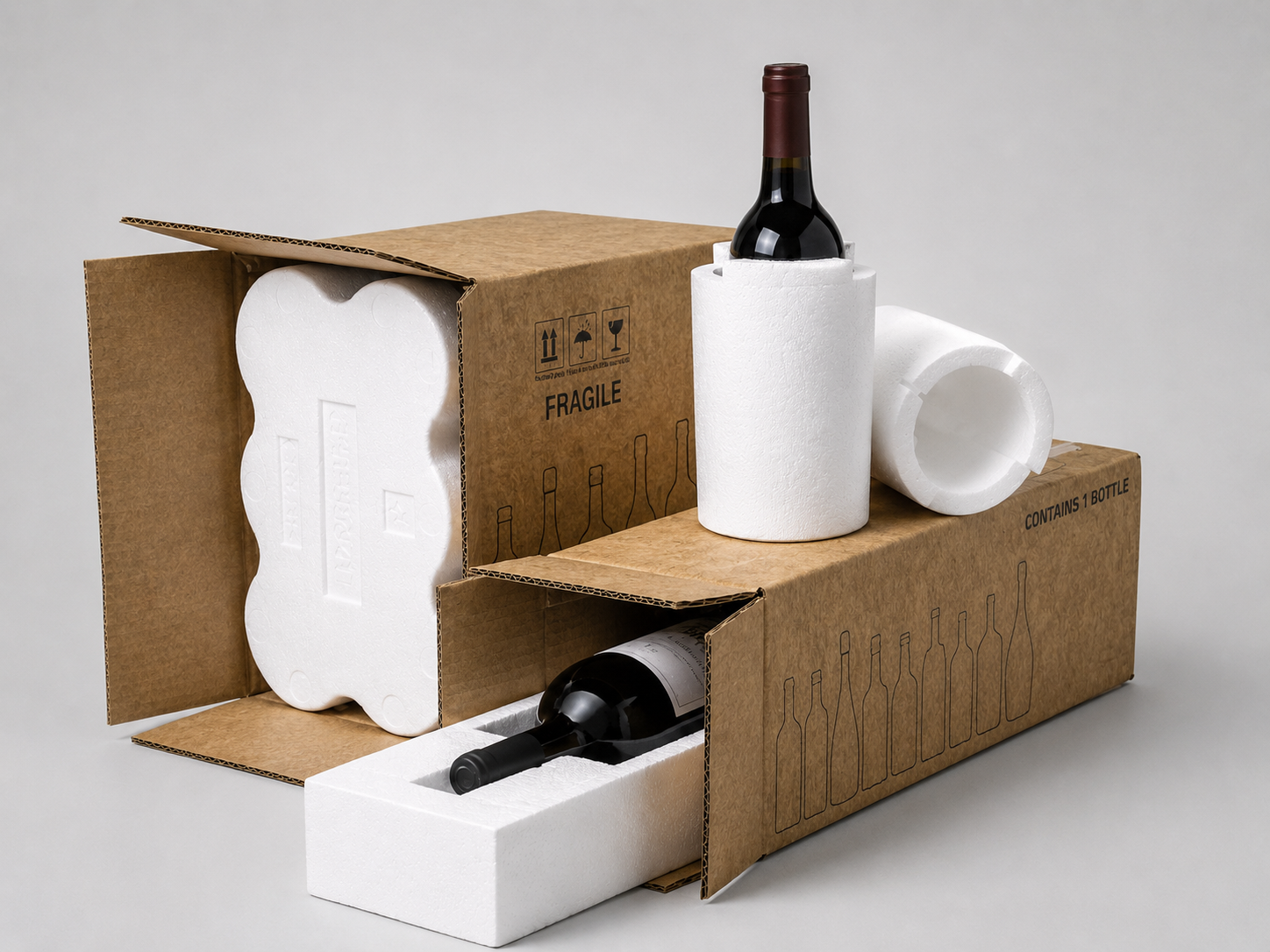
Where it works. Foam inserts cradle the bottle, protect well, seat fast, and add thermal insulation, which is a real reason to choose them for high-value wine or some international routes.
Where it struggles. Foam takes a lot of storage space, does not align with the direction of Europe’s PPWR, is rarely collected for recycling, and tends to give a poor unboxing experience.
Best for. A limited number of high-value parcels where thermal insulation matters more than waste and storage volume.
Corrugated cardboard systems
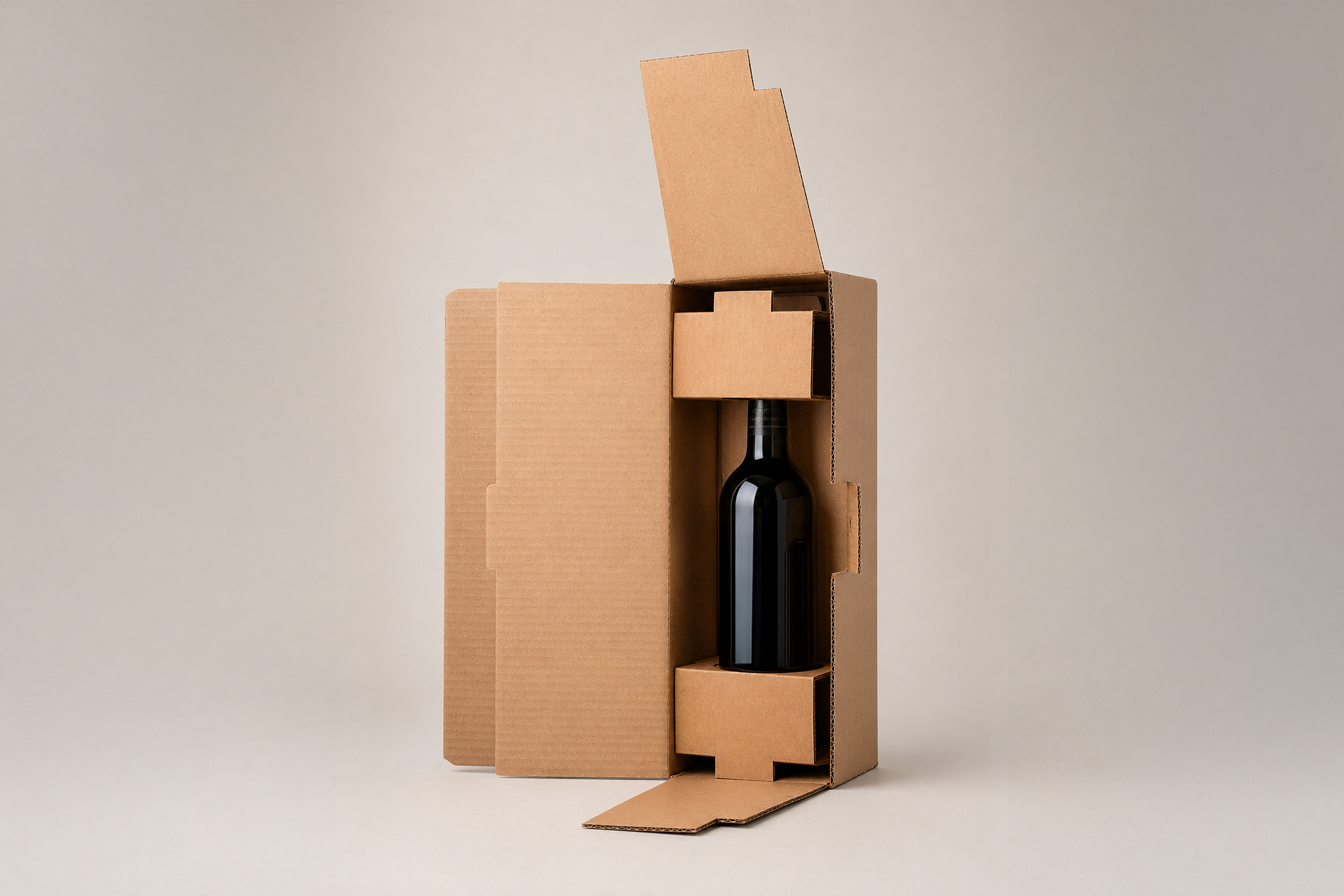
Where it works. Corrugated systems usually ship flat, take less room than foam, and recycle easily. Good designs adapt to several bottle types, including Bordeaux, Burgundy and champagne formats, which can cut the number of formats you stock.
Where it struggles. They require folding, locking or shaping before use, sometimes with extra components. Protection depends on correct assembly, which takes time and effort.
Best for. Brands that want a recyclable, plastic-free option and have a trained team that can pack it consistently.
Molded fiber trays
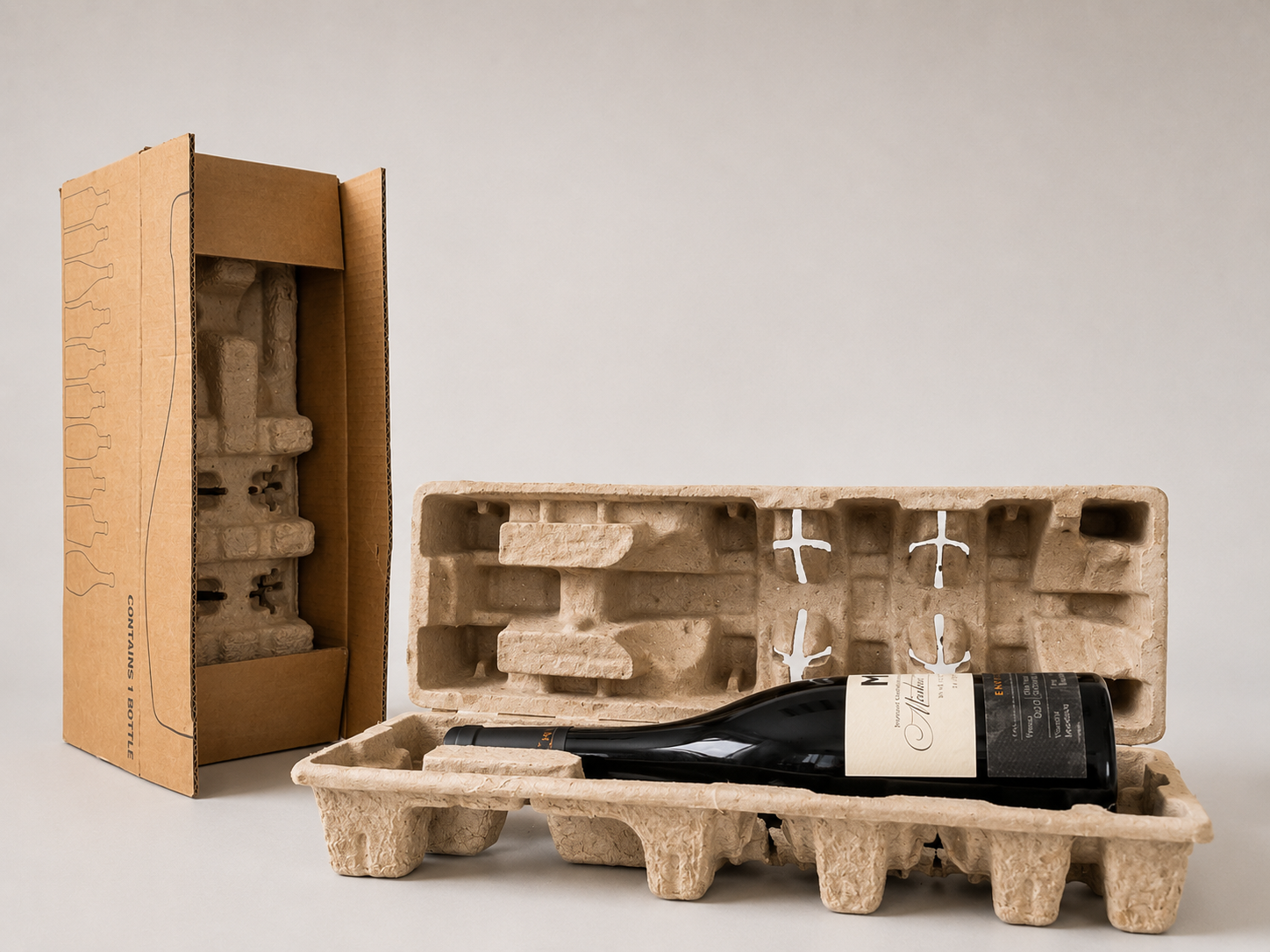
Where it works. This is the most adaptable of the paper-based options, and for most bottle shippers it is the best all-round choice. An adaptive molded fiber tray, such as UniGlass, is engineered around the bottle: 3D buffer zones support the body, base, shoulder and neck and hold the bottle off the box walls, so it does the protective job foam does, in paper. It is recyclable in the paper stream, it nests to save storage, and packing is one clean drop-in step, with no folding, no pump and no extra fill. Because the buffer zones take a range of bottle profiles rather than one molded shape, a single tray can cover several formats, which cuts the number of packaging items you stock.
Where the alternatives fall short.
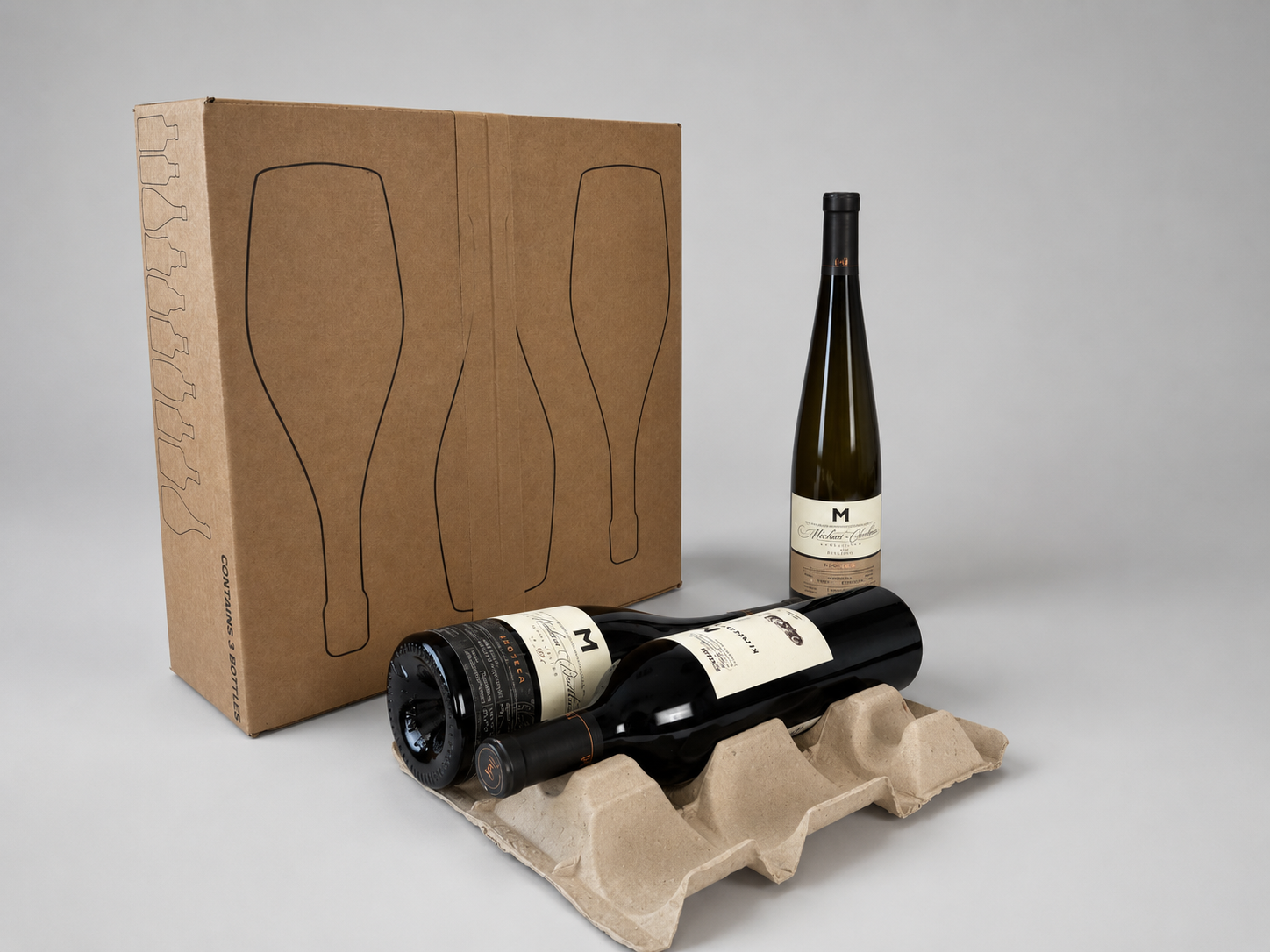
Not all pulp is the same. A plain pulp divider only keeps bottles apart and can leave the base and neck exposed, which is not the same as an engineered tray with buffer zones. Foam matches the protection but is bulky and not recycable at scale. Inflatable bags add a pump and provide medium protection. A paper-based sleeve protects only the body. An adaptive fiber tray is the option that avoids each of those catches at once.
The test. UniGlass passed a 150 cm drop test in an ISTA laboratory, well above the standard drop height for a parcel of this weight, with full ISTA 3A certification in progress at an external accredited lab. For a specific courier or bottle configuration, the test is validated for that exact setup.
Best for. Most bottle shippers who want one paper-based system that balances protection, packing speed, storage, fewer formats and recyclability.
Inflatable bottle bags
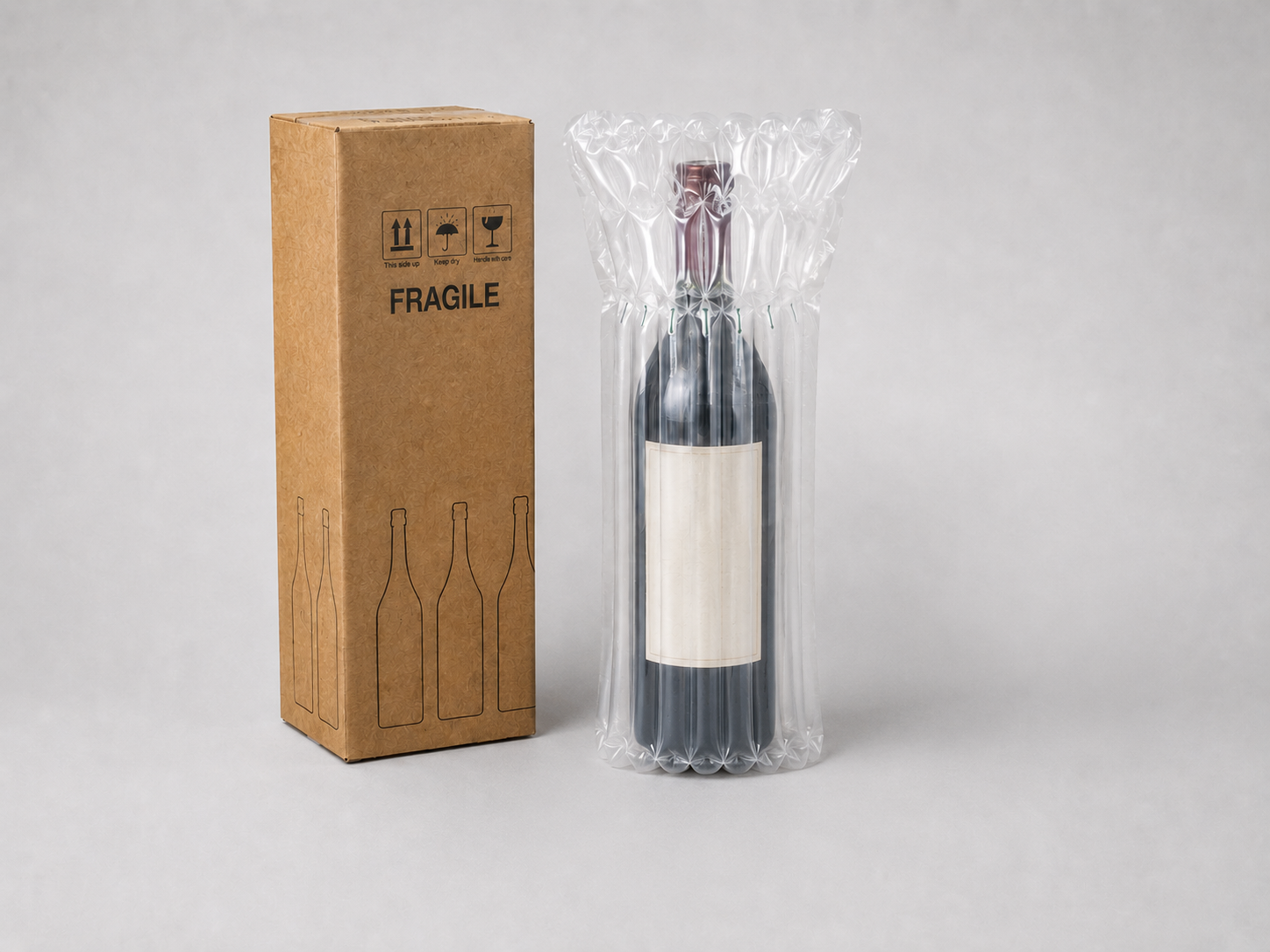
Where it works. They ship flat and save storage space before use, which suits small runs or seasonal peaks.
Where it struggles. The bag has to be inflated, which means a pump, compressed air or a station, and every extra motion is a cost at volume. When packaging is done by a fulfilment center, this extra step increases the packaging cost significantly. The inflated bag still goes inside an outer corrugated box, so it is an extra component, not a replacement for one. It is a plastic solution, and protection depends on correct inflation and the air staying in the chambers.
Best for. Low-volume or occasional shipping where flat storage matters more than packing speed.
Honeycomb sleeves and paper wraps
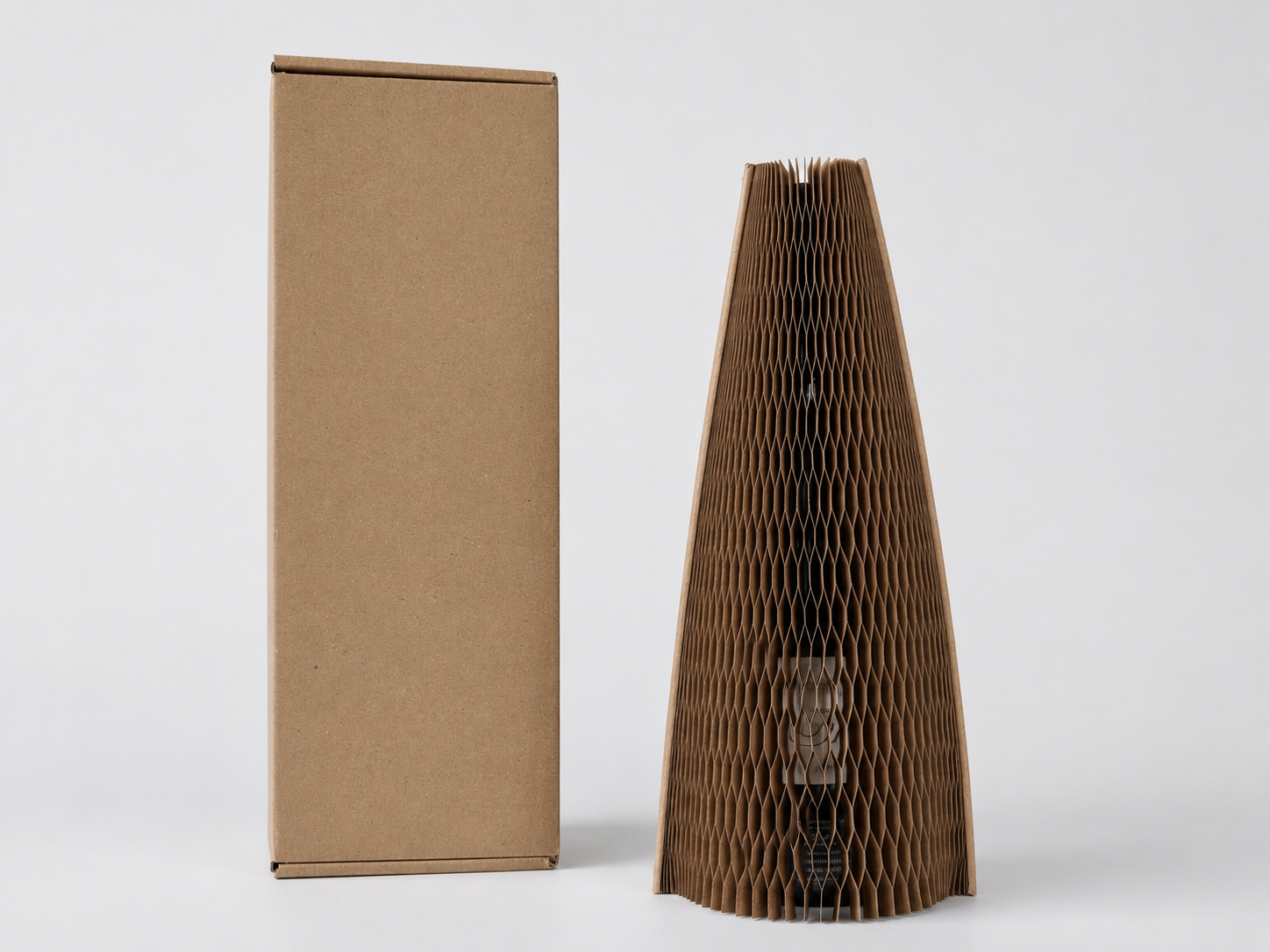
Where it works. They are light, plastic-free, and give a good unboxing moment, which suits gifting and in-store presentation.
Where it struggles. A sleeve mainly protects the body. In transit, the neck and base need protecting too, and a sleeve does not control movement inside the box. A sleeve on its own, or with the wrong box, is rarely accepted by couriers.
Best for. Presentation and gifting for in-store shopping, not courier delivery.
Bubble wrap, loose fill and decorative sleeves
For courier shipping of glass, these are not a protective system. FedEx lists them among the methods that are "not permitted by FedEx for wine shipments." Single and double-wall corrugated partitions let adjacent bottles touch. Polystyrene peanuts and loose fill settle in transit, so a bottle can reach its neighbor or the box wall. Wadded or paper dunnage compresses and lets the bottle move. Air cellular cushioning, plain bubble wrap, is rated not preferred, and only works with at least 2 inches of material on every side, top and bottom, locked to the bottle with extra void fill. Results also vary with the packer: the number of layers, where the tape goes, whether the neck is covered.
Quick comparison
Bottle transit packaging compared
|
Foam |
Corrugated |
Pulp dividers |
Inflatable Bags |
Honeycomb |
UniGlassmolded fiber |
| Protection |
●●●●● |
●●●○○ |
●○○○○ |
●●●○○ |
●●○○○ |
●●●●● |
| Packing speed |
●●●●● |
●●○○○ |
●●●●● |
●●●○○ |
●●●○○ |
●●●●● |
| Bottle coverage |
●●●●○ |
●●●●○ |
●○○○○ |
●●●○○ |
●●●●○ |
●●●●● |
| Storage |
●○○○○ |
●●●●○ |
●●●●○ |
●●●●● |
●●●●○ |
●●●●○ |
| Recyclable at scale |
✗ |
✓ |
✓ |
✗ |
✓ |
✓ |
| Plastic-free |
✗ |
✓ |
✓ |
✗ |
✓ |
✓ |
| Thermal insulation |
✓ |
✗ |
✗ |
✗ |
✗ |
✗ |
Scale: five dots, more filled is stronger. The ratings summarize the trade-offs, not lab scores, and protection assumes the full tested system is packed correctly. UniGlass has passed a 150 cm lab drop, with ISTA 3A certification in progress.
On paper the adaptive fiber tray covers the trade-offs at once. Whether it holds your specific bottle is a question only your bottle can answer. Test the fit with free samples.
How to choose the right bottle packaging
The best packaging depends on your product, your courier requirements and your packing process. Work through these eight factors.
1. Bottle shape and size
A Bordeaux, Burgundy, champagne, spirits or olive oil bottle can differ in height, diameter, shoulder, closure and weight. Check the minimum and maximum diameter, the height, the full bottle weight, the shoulder, the neck and closure, and whether the label rubs easily. A solution that suits one wine bottle may not hold a heavier spirits or champagne bottle.
2. Number of bottles per shipment
A single bottle and a six or twelve-bottle pack carry different risks. Multi-bottle packs need movement controlled in every direction, including vertical and diagonal. Dividers alone are often not enough.
3. Packing speed
Packing time is easy to underestimate. A cheaper material gets expensive if it adds 30, 45 or 60 seconds to every order, especially at peak. Time the real process, including the inner, seating the bottle, any void fill, closing, labeling and the movement check. For example, a drop-in tray can cut a six-bottle order from about 3 minutes to 1. Multiply the time saved by your monthly orders and your packing labor rate to see the real number.
4. Storage space
Pre-formed foam keeps its full 3D shape and takes significant space - one pallet usually stacks between 20 to 48 6-bottle shippers, depending on the design and protection level. On the other hand, flat corrugated, deflated bags and nested molded fiber stack far denser. One pallet of UniGlass triple trays can pack 88 6-bottle packs. Work it out in pallets: how much space does a month of stock take, and what is that floor area worth in rent or in picking space?
5. Number of packaging formats
The real question is how many bottle shapes, sizes and pack counts one format can cover. The more a single adaptive format handles, the fewer items you buy, store, reorder and pick, and the fewer picking errors at the bench. Check how adaptive each option is and how many bottles it packs. For example, foam usually needs a separate variant for 1, 2, 3, 4 and 6 bottles. UniGlass covers 1, 2 and 4 bottles with its single tray and 3 and 6 with its triple, and its registered design fits most 500 and 750 ml bottles, so two formats do the work of five.
6. Damage rate and total cost
A broken bottle is rarely just the cost of the bottle. Add the replacement, the reship, the customer-service time, the courier claim, the lost margin, and the customer who does not reorder. Put a figure on one failed parcel, then multiply by your breakage rate. For example, at 2,000 orders a month and a 3% claims rate that is 60 failures; cutting it to 0.4% saves about 52 a month, which usually dwarfs the price difference per insert. Track your current rate first, then compare options on real shipments or a drop test.
7. Recyclability and customer experience
Customers notice packaging, and disposal is part of the experience. EPS foam is rarely accepted in curbside recycling, so the customer is left with waste that can clash with a premium or low-plastic brand. A paper-based pack goes in the household paper stream and is easier to dispose of. It still has to protect the product, but once that is proven, paper-based packaging tends to cut disposal complaints and helps with the PPWR and EPR reporting EU sellers increasingly face.
8. Tested performance
Ask for proof, not adjectives: the ISTA or courier test result, the drop-test report, the tested outer box and bottle weight, photos or video of the exact configuration, and written packing instructions. The test has to match what you ship. A result for one bottle in one box does not automatically cover a heavier bottle or a six-pack, so if a supplier cannot show a report close to your setup, treat it as untested and ask them to run one with your bottle.
What to ask a supplier before you buy
- Was the full system tested, or only the inner component?
- Which standard was it tested to: ISTA 1A, ISTA 3A, UPS, FedEx or another?
- Which bottle type does the test cover?
- What is the full bottle weight?
- Which outer box was used?
- How was the box closed?
- Was it tested for one bottle, three, six or twelve?
- Does it cover your real mix of bottles?
- How long does packing take?
- How much space does a month of stock take?
- What happens to the packaging after unboxing?
- Can the supplier run a test with your own product?
With a claim like "courier approved," these answers are the difference between a useful statement and an empty one.
How to run a packaging trial
A trial does not need to be complicated. Use a representative sample of your real orders, not a perfect lab case.
Choose your most common bottle, your heaviest bottle, and your most fragile or premium one. Include one single-bottle shipment and, if relevant, one multi-bottle pack. Run them on your actual courier route, with your actual packing team, so the result reflects real conditions. Then measure each option side by side. The figures below are examples, to fill with your own results.
What to measure before changing packaging
| KPI |
What to measure |
Before |
After |
| Packing time |
Seconds per parcel |
e.g. 180 sec |
e.g. 60 sec |
| Packaging formats |
Bottle sizes and pack counts covered |
e.g. 5 separate formats |
e.g. 2 adaptive formats |
| Storage |
Pallets or shelves held |
e.g. 3 pallets |
e.g. 1 pallet |
| Damage rate |
Breakages per batch |
e.g. 3% |
e.g. 0.4% |
| Customer feedback |
Complaints and reviews |
Complaints |
Better reviews |
| Total cost |
Packaging + labor + damage + storage |
Price per unit only |
Full picture |
Tip: compare the full packaging process, not only the unit price. Labor, storage, damages and customer experience often change the real cost per order.
Which bottle packaging is best for your business?
There is no single best packaging, only the best fit for your product and volume.
Choose foam when thermal protection is the priority and you ship a limited number of high-value parcels, and plastic and storage are not your main concern. Choose a corrugated system when you want a plastic-free, flat-packed option and have a trained team that can assemble it correctly. Choose inflatable bags for small or seasonal runs where flat storage matters more than packing speed. Choose honeycomb sleeves for gifting and small parcels, as part of a full tested configuration.
Choose an adaptive molded fiber tray, such as UniGlass, when you ship a mix of bottle formats, want fewer packing items and a faster, more repeatable process, and need a paper-based, recyclable solution. It fits online wine and spirits shops, wine clubs and subscription boxes, producers, premium gifting, and fulfillment teams packing several formats. It is lab drop-tested at 150 cm, meeting ISTA 3A requirements; for a specific courier or bottle configuration, the test is validated for that exact setup.
Frequently asked questions
What is the best packaging for shipping wine bottles?
There is no single best option. Foam protects well and insulates but is bulky and plastic. Corrugated and molded fiber are recyclable and store smaller. The right choice depends on your bottle range, volume, packing speed and whether the configuration has been tested.
Can you ship wine in molded pulp?
Yes. FedEx and UPS both accept molded fiber inners when they fit snugly in a proper corrugated outer and have been pre-shipment tested to an ISTA or carrier procedure. A plain divider that only separates bottles is not the same as a tested protective tray.
Do couriers require a specific test for bottle packaging?
They require testing, not a single universal certificate. UPS references ISTA 3A or DIN EN 22248 or its own test lab; FedEx references an ISTA or FedEx procedure. Always confirm the standard, the drop height and the exact configuration tested.
What does "courier approved" packaging actually mean?
On its own, little. Ask which courier and standard, which bottle and weight, which outer box, and whether the full system was tested in the configuration you will use.
How do you stop bottles breaking in the post?
Hold each bottle off the walls and away from its neighbors, protect the neck and base, use a sturdy double-wall corrugated outer closed correctly, and pick a method your team can pack the same way every time.
The bottom line
In bottle transit, the packaging is insurance for the product, the process and the brand, not just a line cost. Foam protects well but is bulky and plastic. Corrugated systems are paper based but need a lot of folding. Inflatable bags save space before use but add an inflation step, still need an outer box, and stay plastic. Sleeves can look excellent but do not perform well in real logistics. For most bottle shippers, an adaptive molded fiber tray such as UniGlass is the strongest all-round choice: lab drop-tested at 150 cm, meeting ISTA 3A requirements, it meets the protection couriers ask for while balancing packing speed, storage, fewer formats, recyclability and unboxing in one paper-based system.
Whatever you choose, do not decide on price per unit alone. Ask for the test, work out the total cost, and run a trial on your own bottles before you switch.
Test UniGlass with your own bottles